


1. What is Welding
Is the fusion joining of two metal or polymer (thermoplastic) parts or materials at very high temperatures. Welding can be done in two ways: with or without the use of a filler material, and when the two materials are joined by melting, the process is called fusion welding.
The filler material is used when the parts to be joined do not have the same physical and chemical properties – usually when different metals or alloys are involved. The filler material can also be used if the weld joints – the spaces left between the parts to be joined – are larger.
Types of materials that can be welded
Depending on the basic elements from which the parts to be welded are made, they fall into the following categories:
- Steels
- Stainless steel
- Aluminum and its alloys
- Nickel and its alloys
- Copper and its alloys
- Titanium and its alloys
- Cast iron
Welding metals is a procedure that has replaced older methods of joining materials, such as riveting.
Here are the advantages and disadvantages of this procedure:
The advantages of welding materials
- Welding allows efficient joining of construction materials and increased integrity
- Welding can be carried out easily with portable machines, both indoors and outdoors
- Continuous welded joints are watertight
- Weld joined materials and parts are more efficient and look better than the riveted ones
- Welding can be done by a wide variety of methods and procedures
- The costs are usually reasonable
- The welding procedure can be both manual and automatic
- Welding can be done efficiently even in tight spaces
Disadvantages of material welding
- Disassembly of welded joints cannot be done without destroying detail parts
- Heat released during welding can lead to degradation of basic material properties
- The released heat can also lead to the distortion of the joined materials
- The welding equipment can be expensive
- During welding, large amounts of residues, fumes and ultraviolet rays are released which are dangerous to humans
- Preparing the joints for welding can be laborious
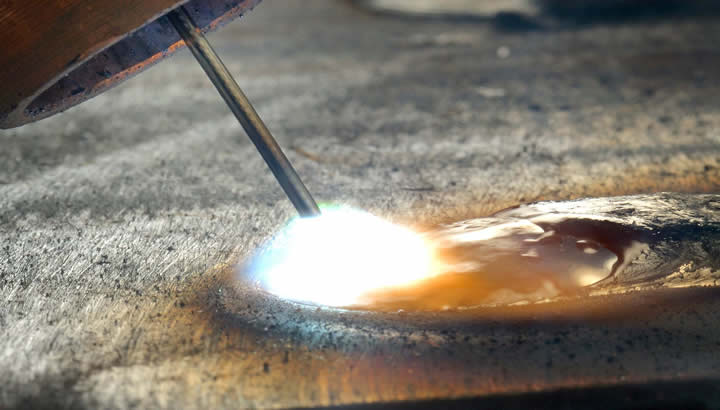
2. Types of welding according to the used energy
a. Electric welding
- with electric arc
- with plasma
- with electron beam
- by electrical resistance
- with high-frequency currents
- with photon beam (laser welding)
b. Chemical energy welding
- with flame
- the aluminum-thermal welding
- the forge fire welding
- welding by explosion
c. Mechanical energy welding
- by friction
- by percussion
- with ultrasound
- cold pressure
3. Welding Procedures
Depending on whether or not filler materials are used, on the condition of the parts being welded and on the machines used, welding is divided into two broad categories:
Fusion welding
It is made with filler materials. These, together with the edges of the parts being joined, form a so-called weld pool – a mixture of metals which, when cooled, will form the actual join between the materials, also called a weld seam.
In the case of fusion welding, it is recommended that the surface that is subjected to the process should be as small as possible, so as not to affect the physical and chemical properties of the materials being joined.
Solid state welding
This is done without the use of additives. The parts are joined by pressure in solid state. This welding procedure can be done with or without heating the parts to be joined.
In addition to the two broad categories above, several other welding and related processes are provided:
- Metal brazing processes – this category includes tinning (soft brazing) and brazing (hard brazing)
- Welding related methods – use the same principles of welding, but do not make joints between two parts. This category includes thermal cutting, steeling, and charge welding.
4. Fusion Welding
Shielded electrode welding – SEI welding
Also known as manual electric welding, this process is the most widespread worldwide. The operating mode is very simple, the welding machine is easy to use and the welding itself does not require extensive experience in the field.
During welding with a coated electrode, the electric arch is produced between the electrode brought into contact with and then withdrawn from the material to be joined. The electric discharge melts the weld pieces and electrode in the molten metal bath, and the electrode sheath – which is a compound of minerals or other substances – releases a cloud of smoke that protects the weld from the atmosphere.
Gas shielded electrode welding – MIG/MAG welding
This is a welding method developed from welding with a covered electrode. The procedure is similar, the main difference is that the electrode is no longer sheathed, and the welding is carried out in a protective gas environment, released by the welding machine.
Depending on the gases used to create the welding medium, the process can be:
- MIG welding – uses inert gases such as argon, helium, or an argon-helium mixture
- MAG welding – uses active gases such as carbon dioxide or inert gas mixtures with carbon dioxide
MIG/MAG welding has several advantages over covered electrode welding:
- high welding speed – 20-100 centimeters/minute compared to 6-20 centimeters per minute
- improved quality
- reduced fume emissions
- reduced stresses and deformations
The biggest disadvantage of this welding process is the difficulty of using it in construction site conditions, where air currents can damage the gaseous coating of the electrode.
WIG non-fusible electrode welding
Unlike welding with fusible electrodes, this process uses a non-consumable tungsten or tungsten non-consumable electrode that does not act as a filler material. The electric arc melts only the welding ends of the two materials or parts to be joined.
The process has the advantage that it can be used to join almost all weldable materials, even materials that require an inert gas environment, such as tantalum, zirconium, and titanium.
Plasma welding
Plasma welding is a more modern version of WIG welding. The difference is that the electric arc is concentrated at one point, using a mechanical or electromagnetic choke, and the plasma column reaches much higher temperatures. The major disadvantage of this type of welding is that the welding generator is more complex, which leads to higher acquisition costs.
Flame welding
Unlike the electric welding, flame welding uses the controlled chemical reaction of a combustible gas mixed with oxygen as a heat source. Flame welding is based on the production of an extremely high temperature that melts the materials to be joined.
The most commonly used compound in this welding process is oxyacetylene. Flame welding is of several types, depending on the type of chemical used for combustion:
- oxy-methane
- oxy-propane
- oxy-hydric
- oxybenzene
Aluminum-thermal welding or fusion welding
It is used in particular in the installation and repair of rail, subway, or tramway tracks. It utilizes the thermo-chemical energy released by the burning of thermite, a chemical compound consisting of a granulated mixture of iron oxide, aluminum, and ferro-alloys for alloying.
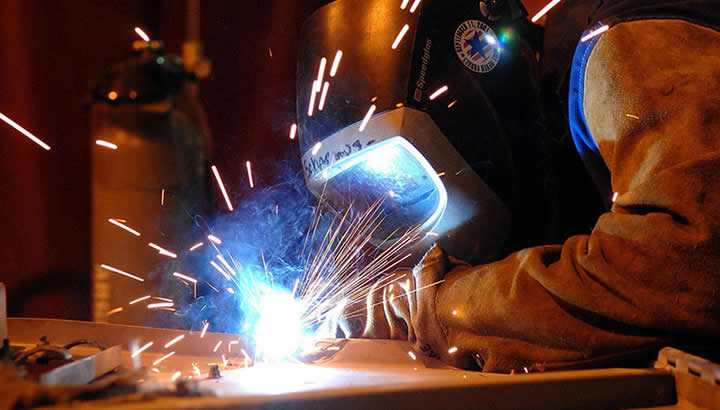
5. Solid State Welding
Electric resistance welding
This process involves fixing the materials to be welded between two electrodes which also have the role of applying the necessary pressure to join them. The current flowing through the electrical system formed by the two electrodes and the materials to be bonded creates a welding point on the contact surface of the two parts being welded.
- end to end
- in points
- in a line
- embossed
- with stored electricity
Cold pressure welding
Cold welding is a process of joining metals in a solid state, without heating the components, carried out exclusively by the application of a continuous force of displacement. The materials to be joined are subjected to a pressure that leads to plastic deformation of the joining area, which must then be removed.
Two types of joints can be made by cold welding:
- end to end
- by overlapping
Cold pressure welding is used for joining conductors, in the manufacture of capacitors, and the materials that allow this process are exclusively non-ferrous: aluminum, copper, but also silver, lead, tin, indium, gold.
Diffusion welding
Unlike cold pressure welding, the diffusion welding is performed at a lower temperature than that which would allow the materials to melt, and the pressure to which they are subjected does not allow their visible deformation.
Diffusion welding is an innovative technique used mainly in the aeronautics, micro-technology, and optoelectronics industries.
Ultrasonic welding
Another innovative welding technique uses ultrasound to join two pieces of dissimilar metals. It is a cold-welding process in which the required energy is applied in the form of vibrations in the joining areas. The frequency of these vibrations is similar to ultrasound, between 16 and 1010 Hertz.
Ultrasound welding is of several kinds:
- in points
- round
- in an interrupted line
- in a continuous line
6. Welding by metals Soldering
Although not technically part of the procedures generically referred to as “welding”, metal bonding is considered by many to be another welding method. The procedure involves using a metal or alloy to bond two materials. The temperature at which the procedure takes place must be lower than the melting temperature of the material from which the parts being joined are made.
Depending on the temperature at which bonding takes place, there are two methods recognized at this time:
Soft soldering (tinning)
Usually done at low temperatures (up to 4000 C). It is mainly used for sealing or for bonding materials that do not require too much resistance.
Among the most commonly used alloys for soft soldering are tin alloys (between 20 – 90%) and lead. Soldered parts are usually made of lead, copper, brass, zinc, or galvanized sheet.
Brazing
The soldering operation is done at temperatures above 400 degrees (most often around 850 degrees Celsius), and the material most often used for soldering parts is brass. Brazing is usually used to join pipes.
7. Related welding processes
In addition to the standard welding methods mentioned above, in the same category there are also a number of processes that are not used for joining materials or parts but use the same principles of welding.
- Thermal cutting – is a method by which parts and materials are cut to the required size. There are several types of thermal cutting: oxygen, plasma, or laser.
- Thermal metallization – is the procedure by which various materials are coated with metals or alloys, often in powder form.
- Filler welding – is a process for reconditioning materials
No matter how simple some welding processes may seem, you should take all the necessary precautions before you start welding: protective equipment and a safe working area. And, if you are unsure about your experience with a welding machine, the best thing you can do is ask a welder for assistance.

